
Ashavari on debut album ‘Goddess from the Machine’, Resilience, Dissociation, & World Building | Exclusive Interview
By Brenessa Roach | May 10, 2026
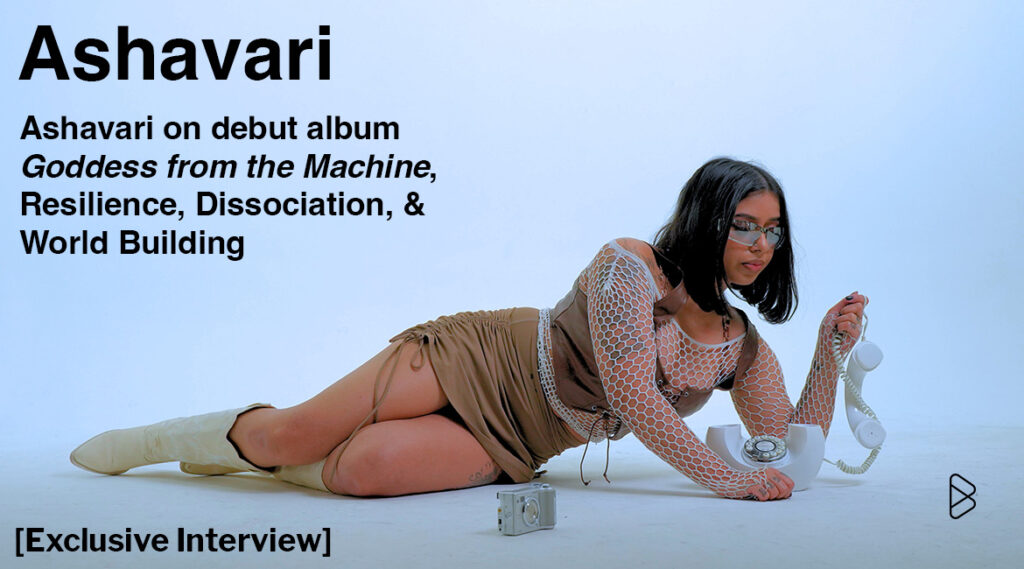
Ashavari, the South-Asian artist is building a world of her own where alternative pop, dark R&B and avant-hip hop collide into something both haunting and deeply personal. From Mumbai to Canada’s Flower City, the raw and ethereal artist draws from a wide spectrum of influences, blending contrasting sounds into a singular, cohesive identity.
Her debut album, Goddess from the Machine, released on Friday, May 8th, feels like the clearest expression of that vision yet. Deeply personal and emotionally layered, the project explores the resilience of being a survivor through a cinematic, genre-fluid lens.
When asked about the meaning behind the album’s title, Ashavari describes it as a reflection of transformation.
“GFTM actually means Goddess from the Machine. I think the name kind of comes from the idea of resilience…I’ve known for a long time that I’ve wanted to do this, to take a lot of my personal experiences that are very intense, even traumatic, and tell it through almost like a third-person story that follows this journey of anyone who’s been through some of the things that I’ve been through…I’m showing my mental health journey, my cPTSD, and how I was able to come out of it, or how we as survivors turn into gems after transmuting our pain into authentic self-expression and art.”
Ashavari’s journey across genres is layered, with each phase building into the next rather than replacing it.
“At one time, I thought I was going to go to Berlin and pursue opera and just be a choir girl for life. But at the same time, a lot of the heavy metal music that I listened to was heavy metal with opera vocals, so it actually went hand in hand. So the opera and the metal was like the same stage of my life and when I was pursuing that and singing opera over bands, I learned so much. We performed so much. I really, really loved the heaviness contrasted with the higher pitch soprano vocals. It was honestly everything I lived and breathed.”
That world, however, came with its own set of challenges, ones that ultimately pushed her to step away.
“Being a brown woman in an alternative genre is not easy, because people always put you in boxes, or don’t expect that you really have the talent or the knowledge to take up that space. Like, you always have to prove what bands you listen to, or you always have to prove that you’re not just the merch girl. I used to get that a lot and on top of that, it was really disappointing to see media outlets in the heavy metal scene kind of, you know, put these articles around certain awful things that happened… and they would paint people like me, other women, other people of colour in a way that I found very harmful, in a way that was often victim blaming. I felt very strongly about that at the time. I felt I really can’t align myself with this anymore.”
Taking a break from that environment between 2017-2019 opened the door to new influences and a completely different relationship with music for Ashavari.
“When I was healing from my traumatic experiences, I discovered dance. So I started taking hip hop classes. I used to listen to a lot of R&B because I would take heels as well. So I really loved hip hop and heels, those were my two favourite styles and through that, I developed such a strong love for both genres, hip hop and R&B.”
Even while exploring those newer influences, Ashavari realized something still felt incomplete. The breakthrough came when she stopped trying to force herself into a single category.
“Ultimately, I kind of found myself at a point where I didn’t want to leave the old me behind. I just kind of got to this point where I was like, You know what? It doesn’t feel authentic if I’m just making songs to fit a genre that hasn’t always been as big in my life. I felt like I was neglecting the alternative side of me a little bit… I just didn’t feel like I had my sound yet.”
That realization ultimately led her toward the genre-fluid identity heard throughout Goddess from the Machine, one rooted more in emotion, atmosphere, and storytelling than strict labels.
“I didn’t want to neglect my old self, but I also don’t want to neglect the self that I developed for a few years now through dancing… I wanted to make some songs people dance to, and I learned how to rap…I was like, ‘Oh wow, wait, I really like how this sounds.’ So I decided to kind of incorporate that in my music too, but again, in this darker, grungier way to stay true to sort of what I like and what makes me, me. I want people to hear it and know that this is me… but I also want to be able to explore. I just feel like genre, to me, is mood, as long as there’s an overall concept or cohesiveness.”
That emotional honesty became one of the album’s defining qualities. Throughout the project, Ashavari intentionally approached vulnerability with boundaries, choosing metaphor and world-building as a way to communicate emotional truth without forcing herself to relive trauma in damaging ways. Songs like “Freakshow” and “Hung by the Ribbon” are some of the album’s darkest and most vulnerable moments, exploring fear, survival, and resilience through deeply personal storytelling.
“My intention with this album is not to re-traumatize… I’m not trying to be raw for the sake of being raw. I just want people to know what a survivor feels and what the emotional experience is, and what things like that do to a person. I had pretty strong boundaries when I was writing this album to make sure that I wasn’t gonna expose myself in a way that was gonna re-traumatize me.”
That same balance between honesty and healing also shaped “Frozen Lakes and Earthquakes,” a song that allowed different versions of herself to coexist instead of being separated into different identities or eras.
“Honestly, I learned that I don’t have to compartmentalize to the degree that I was. It was just so nice to be able to have this song that’s old me and present me in an obvious way that other people can hear too.”
For Ashavari, the album became less about revisiting pain and more about creating something listeners could emotionally connect to in a space where people might recognize parts of themselves reflected back through the music.
“I hope people feel seen. I hope we feel less alone and I hope we heal together”
That perspective eventually expanded into the album’s larger world-building and visual identity, shaped heavily by cinematic storytelling, memory, and metaphor.
A major turning point came during a period of creative immersion inspired by Studio Ghibli films.
“Early 2024, winter… I was at home for Christmas break and I decided I’m gonna binge all the Studio Ghibli movies. I just felt so inspired by the storytelling and the world-building. It was like magic.”
That inspiration shaped the project for Ashavari. She began building a character-led narrative capable of carrying emotional truth while creating enough distance to protect herself.
“I was like, ‘you know what? I want to create my story as a character’. I didn’t want it to be re-traumatizing. I also knew I didn’t want to expose myself in a way that was harmful.”
The album title came from the idea of deus ex machina “God from the machine” which represents that final shift, representing an external or internal force that disrupts the cycle and allows something new to emerge. She is subverting the traditional meaning and calling it “Goddess” from the machine because the project is deeply feminine.
Tracks like “Rabbit Hole” and “I Wish I Was A.I.”embody that immersive approach to storytelling. Rather than presenting listeners with a singular narrative, the album unfolds like an emotional labyrinth, where sound, imagery, and fragmented memories slowly reveal recurring emotional patterns. Each track on the album feels like a different chamber within the same universe.
At its core, Goddess from the Machine invites listeners into a fully constructed emotional world: theatrical on the surface, but deeply human underneath.
When asked how it feels to finally release the project, Ashavari admitted the experience has been both exhilarating and terrifying.
“It is so scary. It’s actually terrifying. I’ve been so nervous for the past month. I think I’ve been overthinking a lot, which I am, unfortunately, an overthinker and I’ve been overthinking how I’m gonna talk about it.”
Still, that anxiety exists alongside an overwhelming sense of fulfillment.
“I’ve been so nervous, especially for this interview, but at the same time, I’m so overjoyed and excited. I feel like this little seed that’s been planted in my mind for a very long time is finally here, fully grown.”
For Ashavari, the release feels less like a single moment and more like the culmination of a long, evolving process one that stretches from early ideas formed in 2021 all the way back to the origins of “Red Lace” as a childhood poem.
“If you think about it, I’ve been just having the seed of the idea since 2021, but that poem, ‘Red Lace’, has existed since what… 18 years ago? So it’s just like, wow.”
That long creative journey has ultimately led her to a place of clarity and self-definition.
“I’m just so excited to finally have something out there that feels like a legacy that truly is me… this is the first time I can say this is my sound, or this is who I am loudly and proudly.”
At the same time, she recognizes the uncertainty that comes with releasing something so personal into the world.
“I have no idea how people are gonna receive it and that’s both exciting and nerve-wracking. I’m also curious who’s gonna like what.”
Still, that uncertainty is embraced with openness rather than fear. Goddess from the Machine was created as a complete listening experience, one meant to unfold from beginning to end like a film, anime, or immersive narrative world.
“I really hope you like this album! It’s meant to be listened to front to back, like a movie or an anime… there’s space for everyone.”
We truly enjoyed both the album and the opportunity to dive deeper into the stories, emotions, and creative process behind it. Thank you to Ashavari for such an insightful and thoughtful conversation.
Goddess from the Machine is now available on all streaming platforms. Listen here.
Follow Ashavari:
You can watch the full interview here:
Got an artist or song submission? Visit our Submit Music page.